A fresh start comes with a fragmented shopping list.
Moving to college combines unfamiliar spaces, uncertain shopping lists, and delivery logistics. Students need to decide what belongs in their room before they have settled into it. Their parents are often part of the same purchase decision.
The team’s proposal brings those steps into one service. Its initial audience is domestic and international students moving to universities and community colleges in the Bay Area. Rather than competing on assortment alone, Dorm It frames convenience and personalization as the reason to choose it.
“An all-in-one college supplies provider that simplifies the process of purchasing essential items for college students.”Original presentation · slide 11
The choices behind
the recommendation.
Start with a short intake, not an endless catalog.
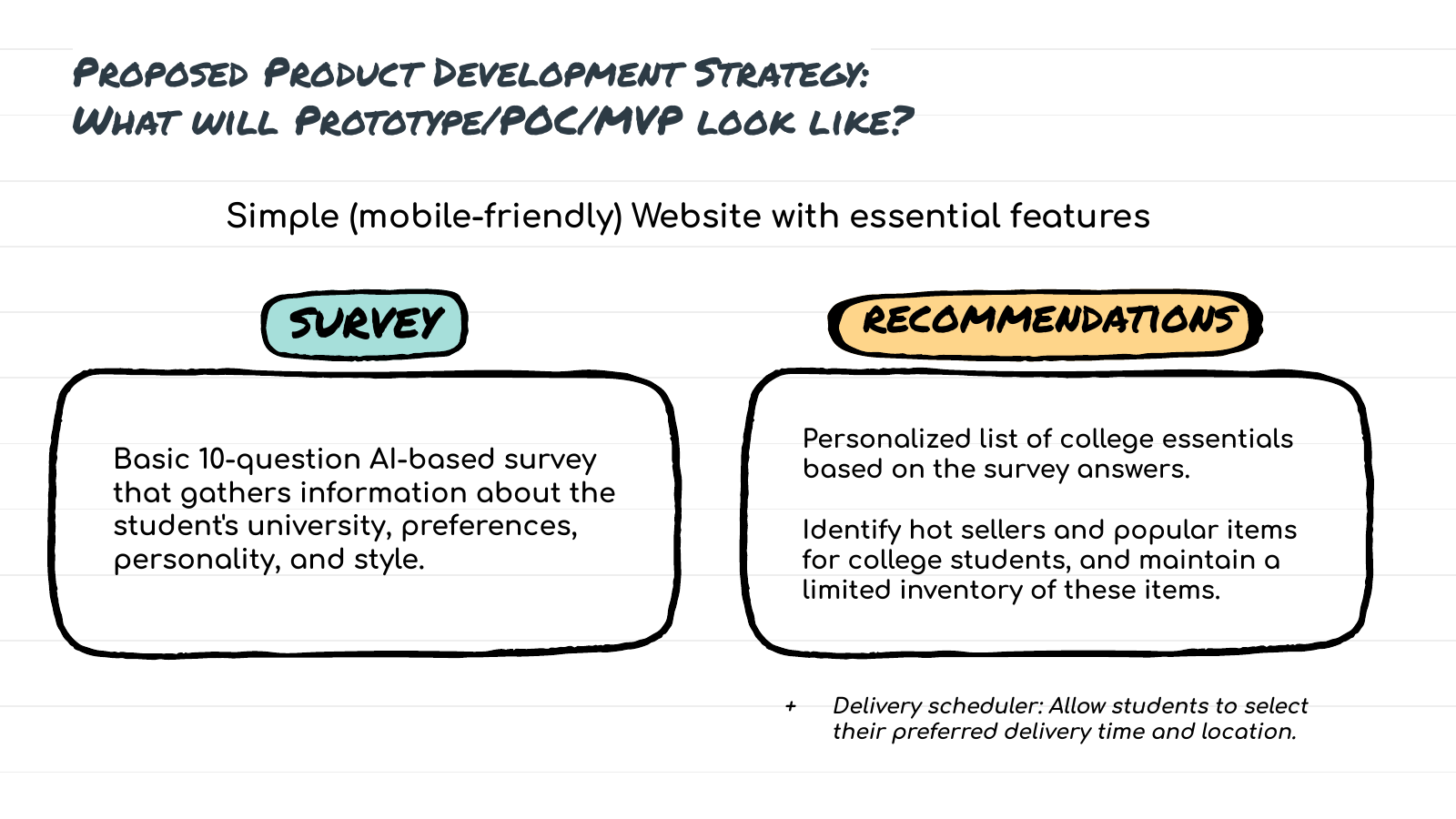
The proposed MVP uses a 10-question survey about university, preferences, personality, and style. Answers inform a personalized essentials list. A mobile-friendly website is the first interface, keeping the path from onboarding to recommendations compact.
An AI-assisted survey is part of the proposal. The recommendation quality still needs to be tested with potential users.
Keep operations inside the product decision.
The MVP includes delivery scheduling and a limited inventory of popular essentials. The distribution proposal uses part-time drivers and dorm delivery, with times arranged in advance. Convenience depends on the handoff as much as the shopping interface.
A narrower assortment gives up catalog breadth in exchange for a more manageable inventory and delivery test.
Validate usefulness before scaling the channel mix.
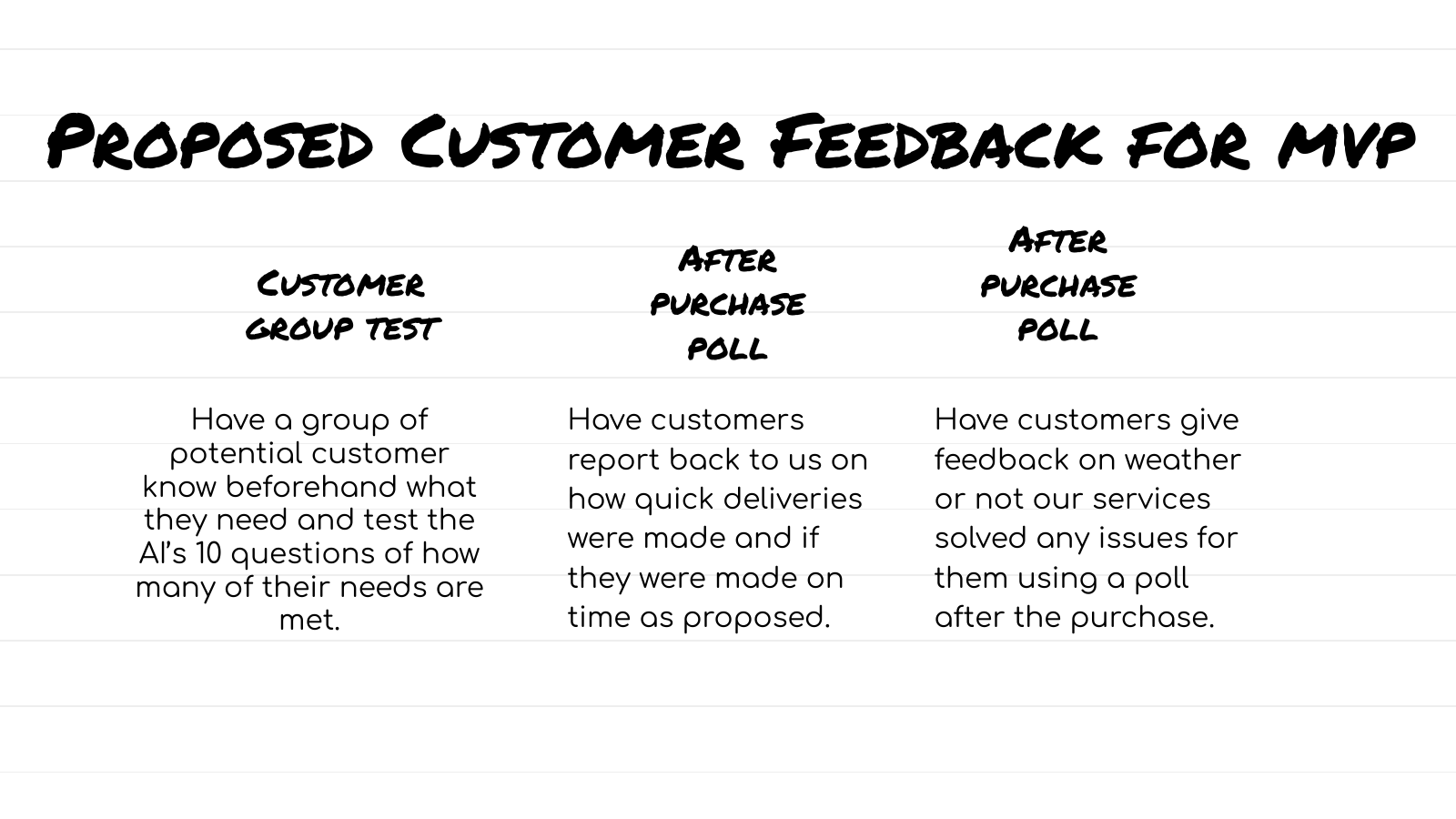
The deck proposes a potential-customer group test, then post-purchase feedback on delivery speed, punctuality, and whether the service solved the student’s problem. Orientation events, referrals, retail partnerships, and digital marketing form the proposed acquisition mix.
The feedback plan is proposed research. No completed user-test sample, conversion result, or delivery-performance result is documented in this deck.
A concept with a path to a test.
The deliverable is a 16-slide team proposal connecting market framing, product development, a proposed feedback plan, acquisition, distribution, and revenue options. The commercial model considers product sales, subscriptions, affiliate revenue, and optional services.
The work shows how a broad move-in problem can become a focused product flow and an operating plan. Its outcome is the proposal itself; launch, revenue, retention, and customer-satisfaction results are not established in the supplied material.
The next evidence to collect
- Test whether the survey captures needs as well as a student’s own essentials list.
- Pilot a small assortment and delivery window before expanding inventory.
- Measure recommendation usefulness, on-time delivery, returns, and repeat demand.
The full thinking,
in the original deck.
Explore the presentation behind this case, including the recommendation, supporting detail, and assumptions.
Read the original deck (PDF)